
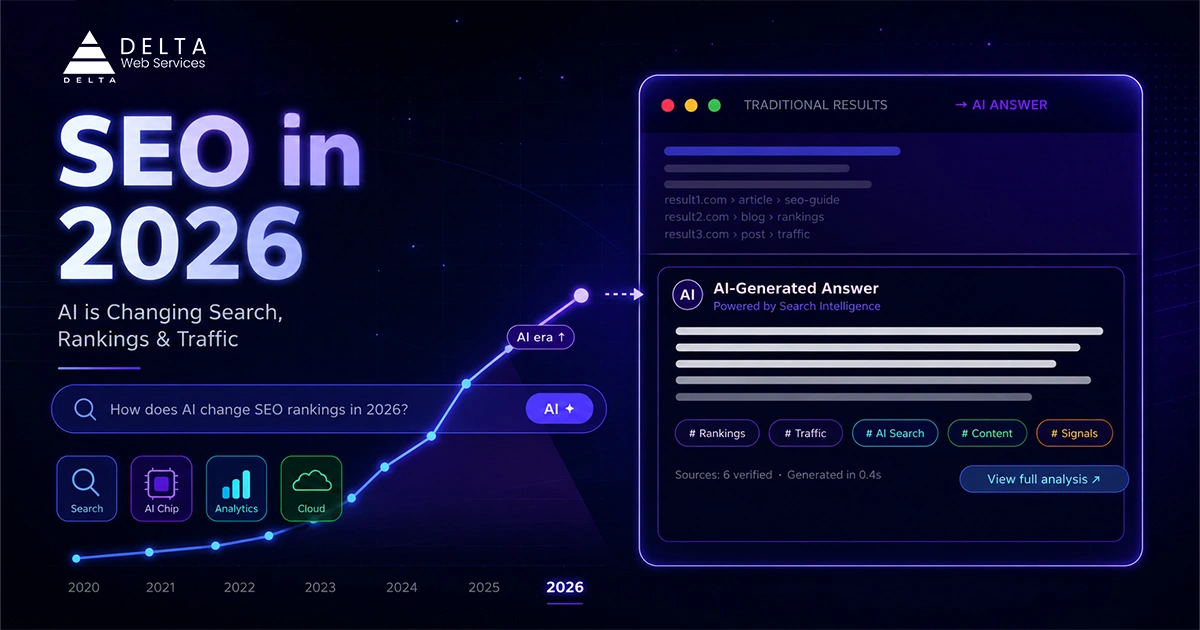
SEO in 2026 is not the same SEO that businesses used five years ago. Earlier, ranking on Google mainly depended on keywords, backlinks, and content volume. Today, SEO is deeply influenced by Artificial Intelligence, search intent understanding, user behavior, and brand authority.
Search engines are no longer just “link providers.” They are becoming answer engines powered by AI systems that summarize information directly on the search results page.
This shift is changing:
- How users search
- How websites get traffic
- How rankings are calculated
- What type of content actually performs
In this blog, we will break down how SEO is evolving in 2026 and what businesses need to do to stay visible and competitive.
1. The Biggest Change: From Search Engines to Answer Engines
Google is no longer just showing “10 blue links.”
Now it shows:
- AI-generated summaries
- Featured answers
- Knowledge panels
- Zero-click results
AI systems like Google AI Overviews power this.
What this means for SEO:
Earlier:
User searches → clicks website → gets information
Now:
User searches → gets answer directly on Google → may not click website
This is called Zero-Click Search.
Impact:
- Informational traffic is decreasing
- Only high-value pages get clicks
- Brand visibility matters more than ranking alone
2. AI Is Changing How Google Understands Content
Google is now using AI models to understand:
- Meaning of content (not just keywords)
- Context of topics
- User intent behind searches
- Relationships between entities
This is called semantic understanding.
Example:
Old SEO:
- “best cloud services” repeated multiple times
Modern SEO:
Google expects related concepts like:
- AWS, Azure, cloud migration
- cybersecurity
- scalability
- DevOps
- hybrid cloud
So now SEO is about topic coverage, not keyword stuffing.
3. Search Intent Is More Important Than Keywords
In 2026, Google prioritizes:
“What does the user actually want?”
There are 4 major search intents:
1. Informational
The user wants knowledge
Example: “What is SEO?”
2. Commercial
User is comparing options
Example: “best SEO tools”
3. Transactional
User wants to buy or hire
Example: “SEO Company near me”
4. Navigational
User searches for a brand
Example: “Ahrefs login”
Impact on SEO:
If your content does not match intent, it will not rank—even if keywords are perfect.
4. Rise of AI Content and Google’s Quality Control
AI tools have made content creation easier, but Google has also become stricter.
What is happening:
- Low-quality AI spam content is being de-ranked
- Generic blog farms are losing visibility
- Helpful, experience-based content is ranking higher
Google now rewards:
- Real experience (EEAT)
- Original insights
- Case studies
- Human editing
- Depth of explanation
EEAT means:
- Experience
- Expertise
- Authoritativeness
- Trustworthiness
5. Topical Authority Is the New SEO Power
Google now ranks websites based on authority over topics, not just individual pages.
Example:
Instead of one blog on “cloud services,” a strong site has:
- Cloud migration guide
- AWS vs Azure comparison
- Cloud security best practices
- Cost optimization strategies
- Industry-specific cloud solutions
This creates:
- Strong internal linking
- Higher trust signals
- Better rankings across all related keywords
This is called Topic Cluster SEO.
6. AI Overviews Are Reducing Organic Clicks
One of the biggest SEO changes is the emergence of AI-generated answers directly on search pages.
What users see now:
- Quick summaries
- AI answers
- Suggested steps
- Source citations
Impact:
- Websites are getting fewer clicks for basic queries
- Only deep, unique, or decision-based content gets traffic
- “Surface-level content” is losing value
Winning strategy:
Focus on:
- Deep guides
- Comparison pages
- Case studies
- Opinion-based content
- Industry insights
7. Technical SEO is Becoming More Important Again
Even though AI is dominating, technical SEO still matters.
Key factors in 2026:
- Fast-loading websites
- Mobile-first experience
- Core Web Vitals optimization
- Clean site structure
- Structured data (schema)
- Proper indexing
Why it matters:
AI systems rely on structured data to understand your website better.
8. Backlinks Still Matter, But Quality Matters More
Backlinks are not dead—but spam backlinks are.
Now Google values:
- Industry-relevant links
- Brand mentions
- PR coverage
- Authority websites
Less effective:
- Bulk backlink submissions
- Low-quality directories
- Paid spam links
9. Rise of Brand SEO (Very Important Trend)
Google now prefers brands that users recognize.
Signals Google tracks:
- Branded searches (people searching your company name)
- Social presence (LinkedIn, YouTube)
- Mentions across the web
- Trust signals and reviews
Example:
A known brand with moderate SEO can outrank unknown sites with strong SEO.
This is a big shift.
10. Community SEO Is Influencing Rankings
Google now shows results from:
- Reddit discussions
- Quora answers
- Forums
- LinkedIn posts
- YouTube content
Why?
Because AI systems trust real human discussions more than generic content.
Impact:
- Community presence increases visibility
- User-generated content ranks faster
- Brand reputation matters more
11. Programmatic SEO is Scaling Traffic
Businesses are using automation to create thousands of pages.
Example:
- /seo-services-los-angeles
- /seo-services-chicago
- /seo-services-nyc
Or:
- industry-specific landing pages
- service + location pages
Benefit:
- Massive keyword coverage
- Faster indexing
- High scalability
12. Future of SEO: What Will Matter Most
SEO in the future will focus on:
1. AI-friendly content
Structured, clear, semantic content
2. Real expertise
Experience-based writing
3. Brand authority
Trust and recognition
4. Multi-platform visibility
Google + YouTube + LinkedIn + Reddit
5. User engagement
Not just traffic, but interaction and conversions
Conclusion
SEO in 2026 is no longer about “ranking pages.” It is about:
- Building authority
- Creating useful, deep content
- Matching user intent
- Adapting to AI-driven search systems
- Building a strong brand presence
Businesses that still rely on old SEO tactics will struggle. But those who adapt to AI-driven search, semantic SEO, and brand-focused strategies will dominate organic visibility.
Final Insight
SEO is not dying because of AI. SEO is evolving because of AI.
The winners in 2026 will not be those who publish the most content, but those who publish the most valuable, trusted, and structured knowledge.


